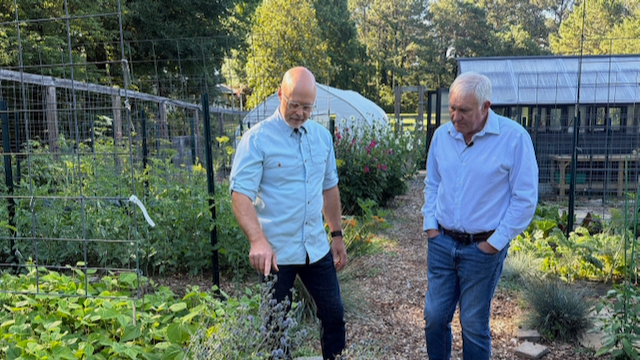
This week, I had the opportunity to give Tim Knight of Isakson Living a tour of the farm. As we walked through the growing areas, I found myself explaining something that has become increasingly important to me as both a farmer and a business leader: diversity is not just something nice to have. It is essential to creating healthy systems.
One of the things we discussed was the variety of flowers planted throughout the farm. At first glance, they simply add beauty and color to the landscape. But their purpose runs much deeper than aesthetics. Different flowers attract different pollinators. Some flowers are designed for larger pollinators like bumblebees, while others attract smaller native bees, wasps, and beneficial insects. By intentionally planting a diversity of flower shapes, sizes, and bloom times, we create an environment that supports a much wider range of life.
The result is a healthier and more resilient ecosystem.
The same principle extends beyond pollinators. Around the farm, we maintain hedgerows that provide habitat for birds. Those birds help control insect populations naturally, reducing the need for intervention on my part. Of course, there is a tradeoff. I often joke that every farm pays a “blueberry tax” to the birds because they certainly enjoy helping themselves to some of the harvest.
Even so, the value they provide far outweighs the occasional missing berry.
This year, our hedges became home to nesting birds, and we even had the opportunity to watch a young bird making its first attempts to fly. It was a wonderful reminder that when you create the right environment, life shows up in ways you never planned or expected. Tim actually captured a picture of the young bird during his visit, which made the moment even more memorable.
Nature continually teaches the same lesson.
Diversity creates balance.
Diversity creates beauty.
Diversity creates interest.
Most importantly, diversity creates resilience.
A healthy ecosystem is not built around a single plant, insect, or animal. It is built around many contributors, each playing a unique role. The interactions between those contributors create stability that no single participant could achieve on its own. When one species has a difficult season, others help fill the gap. When conditions change, the system adapts because it was never dependent on only one source of strength.
I have noticed the same pattern in my personal life.
Recently, Linda and I enjoyed dinner with two other couples. As the evening unfolded, each person shared stories from their own experiences, careers, families, and journeys. What made the evening memorable was not how similar we were. It was the opposite. Each person brought a different perspective and a different set of experiences to the conversation.
The diversity of stories made the discussion richer.
We all left with a broader perspective because we were able to see life through someone else’s eyes. Different backgrounds created new insights. Different experiences sparked curiosity. Different perspectives helped us appreciate things we may have otherwise overlooked.
The same lesson applies to business.
One of the greatest strengths of any organization is the diversity of talents, personalities, experiences, and interests that people bring to the team. Some people are builders. Some are organizers. Some are visionaries who see possibilities before others do. Others excel at creating structure, maintaining quality, and ensuring that good ideas become successful outcomes.
When a team embraces those differences rather than trying to eliminate them, balance begins to emerge.
People challenge one another’s assumptions. They fill gaps that others cannot see. They bring strengths that complement one another rather than compete with one another. The result is often far better than what any individual could have accomplished alone.
I see this principle extend beyond our internal teams and into the clients we serve. Every client has unique goals, challenges, cultures, and perspectives. Working with organizations that are different from one another exposes us to new ideas and new ways of solving problems. Over time, those experiences make us stronger advisors because we gain wisdom from seeing a variety of situations rather than repeating the same experience over and over again.
The strongest systems are rarely built on uniformity.
Nature thrives because of diversity, not despite it. The healthiest ecosystems are made up of many different contributors working together in ways that create balance, resilience, and growth. Whether we are talking about a farm, a family, a team, or a business, the goal is not to make everything the same. The goal is to create an environment where different strengths can work together to produce something better than any one contributor could create alone.
That is a lesson worth carrying from the farm into every area of life.
Until next time,
Cheers from Farmer Tommy!
This post first appeared on June 7, 2026 in Sowing Success, my weekly LinkedIn newsletter on leadership and organic farming. Read the original on LinkedIn.


