Sometimes progress depends on tools you do not own
One of the brightest spots on the farm lately has not just been the infrastructure improvements themselves. It has been the people who helped make them possible.
I do not have a tractor, which means there are some jobs I simply cannot do on my own. And recently, I have found myself depending on the generosity of friends, neighbors, and family to move forward on projects that would otherwise stay stuck.
What has struck me is that they did not just bring equipment. They brought creativity, judgment, and willingness.
That looked like figuring out how to lift a 1,500-pound bag of soil at the upper limits of what a tractor could handle. It looked like carefully setting stair treads that weighed more than 350 pounds each. It looked like problem solving in real time, with patience and good humor, to make something hard feel possible.
It is amazing what can be done with the right tools and the right people.
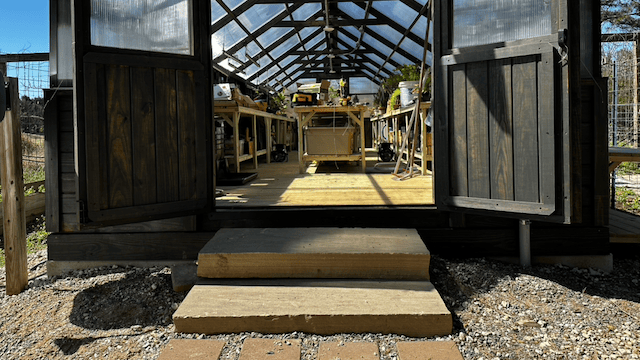
The stone steps in the header image are one of those fruits. Every time I walk up those solid steps, I will think about Jeff and the generosity that helped make them possible.
Asking for help is an act of humility
There is a part of me that wants to be self-sufficient.
I like being capable. I like figuring things out. I like making progress through effort and determination.
But this season on the farm has reminded me that self-sufficiency can quietly turn into isolation if I am not careful.
There are moments when the better path is not pushing harder on my own. It is humbly asking for help.
That is not always easy.
For many of us, giving help feels natural. Receiving it can feel uncomfortable. It can make us feel indebted, exposed, or somehow out of balance. I have even had moments of feeling guilty about how much help I have received.
But when those feelings come up, I have been trying to remind myself of something important.
In receiving someone’s gift of time, strength, or equipment, I am not just taking. I am also creating space for connection.
I am giving them the opportunity to show up as a good neighbor.
I am giving them the chance to participate in something meaningful.
And maybe just as importantly, I am helping build the kind of relationship where they may feel more comfortable asking me for help one day too.
Community often starts when someone is willing to receive
We often talk about community in terms of giving.
Show up. Pitch in. Be generous. Serve others.
And all of that matters.
But real community is not built only through giving. It is also built through receiving.
Someone has to go first in the cycle of reciprocity. Sometimes that first move is not offering help. Sometimes it is asking for it.
That is what creates the opening.
That is what tells another person, “You are needed here.” That is what turns neighboring into community.
Receiving can feel like weakness when you are used to being the one who carries things. But I am learning that receiving is its own kind of strength. It takes humility. It takes trust. And it takes a willingness to let relationships be uneven for a while, knowing they do not have to stay that way forever.
Not every season is balanced. Not every relationship is perfectly symmetrical in the moment. That is okay.
What matters is being open-hearted enough to receive, and awake enough to reciprocate when your time comes.
The lesson beyond the farm
This does not just apply to moving soil or setting stone steps.
It applies to leadership.
It applies to teams.
It applies to client relationships.
In business, many of us are far more comfortable being the helper than the one needing help. We want to be the one with the answer, the one bringing value, the one carrying the load.
But healthy teams and healthy partnerships are built on more than contribution. They are built on trust.
And trust grows when people know they can both give and receive.
Sometimes the strongest thing a leader can do is ask for help. Sometimes the healthiest thing a team member can do is admit they cannot do it alone. Sometimes the best thing a client relationship can include is enough honesty to say, “We need another perspective here.”
That kind of humility does not weaken a relationship. It deepens it.
What I am taking with me
These new steps on the farm are practical. They solve a real problem. They make the greenhouse more usable.
But they are also something more.
They are a reminder that progress is often a shared effort. They are a reminder that asking for help can be the beginning of stronger community. They are a reminder that generosity leaves a mark you can walk on every day.
And maybe that is one of the quiet gifts of this season.
Sometimes the infrastructure we are really building is not just on the land.
It is between people.
A question to carry with you
Where in your life or work might receiving help be the very thing that opens the door to deeper trust, stronger relationships, and a more meaningful kind of community?
This post first appeared on March 13, 2026 in Sowing Success, my weekly LinkedIn newsletter on leadership and organic farming. Read the original on LinkedIn.


