The Lesson of Too Much Rain
This growing season has reminded me that balance in nature is often more important than abundance.
Our weather patterns this year have been extreme. We seem to get several days of heavy rain followed by stretches of little or no rain at all. While plants certainly need water, these dramatic swings create challenges that many people don’t see. One of the biggest is fruit splitting.
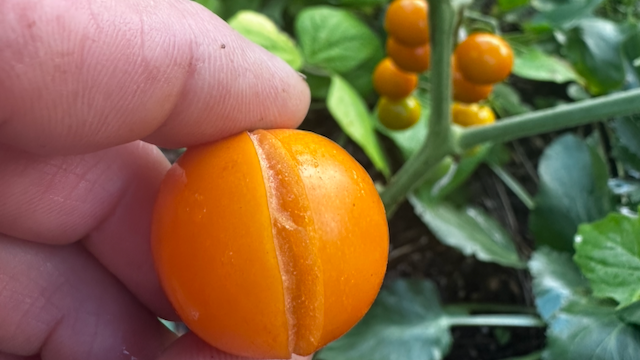
My Sun Gold tomatoes are notorious for this. After dry conditions, a sudden soaking rain causes the plants to rapidly absorb water, and the fruits swell faster than their skins can keep up. This season, I’m seeing nearly half of my ripe Sun Golds splitting on the vine. Even my blueberries are splitting this year, something I’ve never experienced before.
I have to admit, though, every problem presents an opportunity.
As I harvest, I snack on the split tomatoes that can’t make it into the store, and the extras have become a wonderfully simple marinara sauce that pairs perfectly with my breakfast eggs. Some of my favorite meals this season have come from fruit that otherwise would have been considered a loss.
When people hear about all the rain we’ve had, they often say, “Your farm must be loving this weather.” And to a point, they’re right. Gardens and farms need rain. But too much of a good thing eventually becomes a problem. Excessive moisture increases disease pressure, encourages fungal issues, and damages fruit quality.
Moderation matters.
The lesson extends far beyond the garden.
In business and in our personal lives, we often assume that more of something good must automatically be better. More work. More growth. More opportunities. More activity. Or on the other end of the spectrum, more rest, more downtime, and fewer responsibilities.
The reality is that healthy systems usually thrive within a range of balance. It is normal and even beneficial to experience cycles of busyness and slower seasons. But when the swings become too extreme, stress begins to surface, cracks appear, and problems emerge that were previously hidden.
Too much work can lead to exhaustion, poor decisions, and strained relationships.
Too much inactivity can create complacency, loss of momentum, and uncertainty.
The extremes themselves become the challenge.
One of the blessings on the farm this year has been my high tunnel. The tomatoes growing underneath it have been protected from much of the sudden rainfall. The high tunnel doesn’t eliminate every problem, but it dampens the extremes. It creates a more stable environment where the plants can thrive despite the unpredictability outside.
That has made me appreciate something I have also learned in business.
Good systems act like high tunnels.
At ThreeWill, our EOS implementation has given us structures that help reduce the impact of our own organizational weather. Our operational scorecard provides early visibility into what is happening in the business. Our meeting rhythms create consistency. Our accountability systems help us respond to challenges before they become crises.
We cannot control every market condition, every customer decision, or every unexpected event.
But we can build systems that help us absorb the shocks and create greater predictability.
Nature continues to remind me that life isn’t about eliminating change. It’s about creating resilience.
Whether it’s a high tunnel protecting tomatoes from too much rain or an operational scorecard helping a company navigate uncertainty, intentional systems help us avoid being tossed around by every extreme.
Because sometimes, even good things need boundaries.
And sometimes the secret to thriving is not getting more rain.
It’s learning how to manage it.
This post first appeared on June 19, 2026 in Sowing Success, my weekly LinkedIn newsletter on leadership and organic farming. Read the original on LinkedIn.


