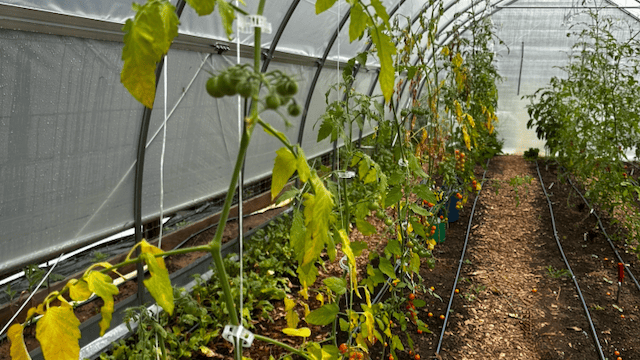
This season has been a significant one for experimentation, and I have a tomato story to share. I know not everyone likes tomatoes (my wife included), but it frames a lesson I learned in the field.
So, a little backstory…
For several years, I’ve battled what I believe is early blight in my tomatoes. Every season seemed to follow a similar pattern. The plants would start out beautifully, but eventually disease would begin working its way through the leaves and production would decline long before I hoped.
Each year seemed to get a little worse.
This year, I decided to try two new things: growing tomatoes under the new high tunnel, which you’ve seen in earlier posts, and tomato plant grafting (this link will give you an 11-second visual. Of course, it’s paired with a Green Day song).
I grafted my apple trees years ago, but never considered grafting tomatoes until this season. By grafting my favorite tomato varieties, like Sun Golds, onto vigorous, disease-resistant rootstock, I hoped to give the plants a stronger foundation. I wasn’t sure how much difference it would make, but it seemed promising enough to try.
At the same time, I invested in infrastructure to improve how I grow tomatoes. We put a greenhouse in the middle of the farm and added a high tunnel. One of my biggest assumptions was that protecting the plants from rain would dramatically reduce disease. Wet leaves and rain splashing soil onto lower foliage are often contributors to fungal diseases, so I expected growing under cover would be the biggest breakthrough.
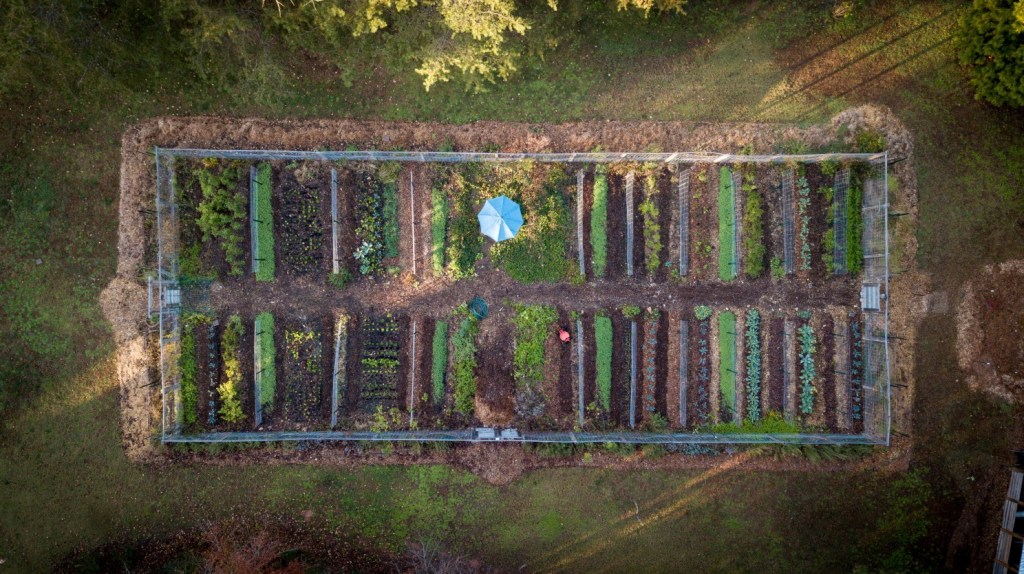
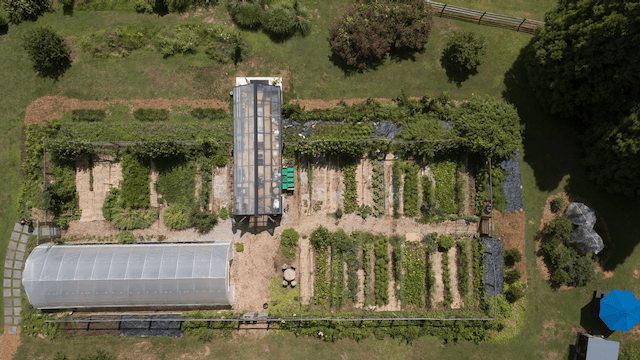
My experiments on the farm have also changed the farm itself. Looking back at a drone photo from 2021 compared to today reminds me that meaningful improvements rarely happen because of one big decision. They happen because of years of trying new ideas, keeping the ones that work, and building on them season after season.
The interesting part is that both experiments have been valuable.
The high tunnel has opened up entirely new growing possibilities. I’m using the lower and lean method for the first time (if you’re curious, this silly guy on TikTok explains it well in a minute), allowing a single tomato vine to continue growing throughout the season. Instead of topping the plant, I lower it and lean it along the row, creating one incredibly long vine that just keeps producing.
But when it comes to disease resistance, the biggest surprise has been the grafting.
The tomatoes growing on grafted rootstock are outperforming my expectations. They have remained healthier despite being exposed to many of the same environmental conditions. While the high tunnel certainly provides benefits, it hasn’t been the primary reason the plants are thriving.
That wasn’t what I expected.
A real-life experiment in the field corrected my assumptions.
One of the things I love most about farming is that nature doesn’t care about my theories. Plants simply respond to reality. The only way to truly know what works is to try something different and observe the results.
As you know, I like to inform my life in my consulting business from what I learn on the farm. This lesson of experimentation definitely has its place building a consulting business and keeping that business relevant.
At ThreeWill, we constantly experiment with new services, new workshop formats, new messaging, and new ways of helping organizations improve how they work. We can study the market, interview customers, and build business cases, but until something is tested in the real world, it’s still just a hypothesis.
Sometimes the thing we’re convinced will make the biggest difference barely moves the needle.
Other times, a smaller experiment quietly becomes the breakthrough we weren’t expecting.
Progress comes from creating opportunities to learn.
That means being curious enough to try something new, humble enough to admit when our assumptions are wrong, and disciplined enough to measure the results instead of defending our original ideas.
The farm reminded me this week that experiments are not about proving ourselves right. They’re about discovering what’s actually true. And once the field teaches us something new, we can build the future on something much stronger than assumptions. We can build it on experience.
Are you experimenting enough in your business?
Do you have a persistent problem you’ve wanted to solve for years, but find yourself trying the same solutions over and over? Maybe it’s time to be brave enough to run a new experiment. You never know which one will change everything.
This post first appeared on June 28, 2026 in Sowing Success, my weekly LinkedIn newsletter on leadership and organic farming. Read the original on LinkedIn.


