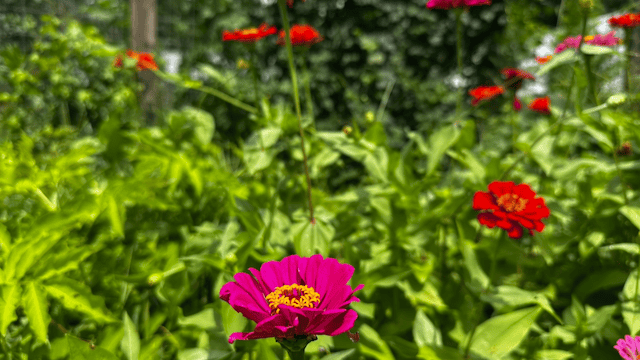
I returned to the farm this week after being away for more than a week. One of the first things I did was walk the property to see how everything had held up while I was gone. It did not take long to find a few problems. There were several stressed areas where my automated irrigation system was clearly not working as planned. Plants that I had intentionally planted, carefully laid out, and expected my irrigation system to support were showing the signs of a short stretch of hot, dry weather.
Then I walked past another part of the farm that caught my attention for a very different reason.
This particular area is not one I have carefully planted or irrigated. Flowers have self-sown there over the years, dropping their own seeds and returning the following season. There are also hops growing in the area that I thought I had pulled up. Apparently, I did not get all the roots, which anyone who has tried to remove hops will probably understand.
What struck me was how vigorous everything looked.
We had just been through a short drought, yet these flowers were not showing the same signs of stress I was seeing in other parts of the farm. I had not started the plants in the greenhouse. I had not carefully selected the planting date. I had not transplanted them into the field or run irrigation to them. Nature had created the seed, allowed it to fall, and somehow that seed found a fertile place to rest. Then, when the timing was right, it germinated and began to grow.
Nature decided when it was ready.
I started thinking about how different that was from much of what I do as a farmer. I decide when to start a seed. I control the temperature in the greenhouse. I decide when to transplant it. I determine where it will grow, how much water it will receive, and sometimes even how much sunlight reaches it. There is nothing inherently wrong with any of that. Farming requires planning, structure, and intervention.
But there is also something to be learned from the plants that found their own way.
I have heard regenerative farmers talk about becoming a co-conspirator with nature. I love that idea. Instead of constantly trying to overpower nature, the goal is to understand what nature is already trying to do and find ways to work alongside it. Sometimes my job is not to force a plant to grow. My job is to create the conditions where it has the opportunity to flourish.
I think the same can be true with people.
Over the years, I have watched people flourish when they find work that connects with something that comes naturally to them. They are curious about it. They pursue it without being asked. They read about it, experiment with it, and find themselves thinking about it when no one has assigned them a task. There is an energy that comes from acting on your own free will and pursuing something you genuinely care about.
You can almost see the difference.
Of course, building a healthy and productive team is not as simple as telling everyone to go do whatever they want. A farm still needs structure. Plants need pruning. Fields need weeding. Sometimes water needs to be provided, and sometimes a plant needs support to keep it from falling over. There are times when intervention is absolutely necessary.
Organizations are no different.
We need clear goals, accountability, processes, and expectations. We need to prune activities that are no longer productive and weed out distractions that compete for our time and energy. We need to invest in people and occasionally provide additional support when someone is going through a difficult season.
But none of those things can overcome bad soil.
The culture of an organization is its soil. It is the environment where people are being asked to put down roots and grow. When the soil is healthy, people have a much better opportunity to gravitate toward their strengths, explore their interests, and contribute in ways that may not have been perfectly planned by a leader or written into a job description.
That does not mean leadership disappears. In fact, I think it makes leadership even more important. The role simply begins to look a little different. Instead of trying to control every aspect of growth, we spend more time creating fertile ground, paying attention to what is naturally emerging, and deciding where a little support might help something flourish.
Maybe the best leaders are co-conspirators too.
Walking through that little patch of self-sown flowers reminded me that I do not always have to be the one with the plan. Sometimes there is wisdom in paying attention to what is already growing, asking why it is thriving, and finding ways to support it.
There will always be watering, pruning, and weeding to do.
But it all starts with the soil.
Keep Growing. Keep Learning.
Farmer Tommy
This post first appeared on July 10, 2026 in Sowing Success, my weekly LinkedIn newsletter on leadership and organic farming. Read the original on LinkedIn.


